Charlottesville Fence & Gate offers fence and gate installation in Keswick, VA, managing the work through fully licensed and insured contractors. Tell us what needs to change, then we can plan the route, material and openings around that purpose.
Start with the property, not just the panel
Keswick addresses include properties with very different fence purposes. Albemarle Extension identifies an equestrian presence in the county, but that does not turn every Keswick yard into a horse-fence job. Tell us whether the request is for a residential enclosure, a field boundary or active turnout.
A decorative rail by the approach and a horse paddock can look similar from the road while needing different materials and gaps. Specify which sections animals can contact and where the route changes to a residential yard.
Bring trailer and tractor access into the first drawing. The gate should work with the actual approach and opening, not just the width of a vehicle parked straight ahead. Any community covenants still need a separate property-specific check.
A layout decision to compare
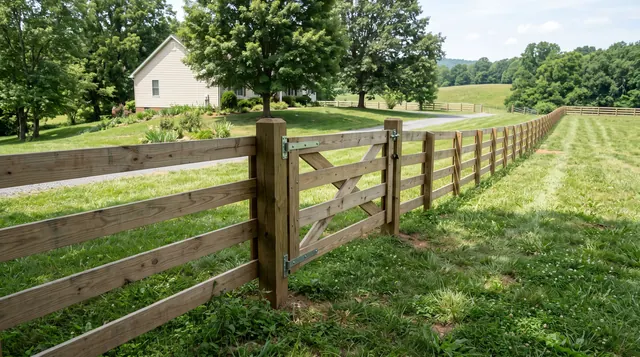
Consider a paddock entrance beside a decorative approach fence. This is a planning example, not a claim about a completed customer job. The entrance needs equipment access, while the adjoining paddock needs continuous containment. Plan the meeting point between the wide gate and the equestrian system, including support and ground gaps. Keep a separate pedestrian route where that makes the daily routine more workable.
Discuss your Keswick fence
Get an Estimate for Your Keswick Property. Include the address, the purpose of the enclosure and the openings you need.
Plan pasture and paddock fencing around the horses
Horse pasture fencing and a smaller turnout paddock serve related but different patterns of use. Identify the horses, their size and behavior, the time spent in the enclosure and the routes between housing, water and turnout. A fence that defines a field visually is not automatically an appropriate containment system.
Board horse fencing, horse-rated woven mesh and horse-rated polymer rails require product-specific selection. Mesh opening suitability, visibility, attachment and the condition of the whole perimeter matter. Avoid exposed sharp edges and protruding fasteners, and isolate a damaged area from use until it has been addressed. No material makes an enclosure injury-proof. The aim is a coherent layout and system that suits the animals and can be inspected and maintained, with advice from the relevant equine and product specialists where needed.
Distinguish an open boundary from an animal enclosure
Split-rail and ranch-rail designs create a visible boundary with substantial open space between rails. That openness may be exactly what you want along a frontage or garden edge. It does not make the same assembly suitable for containing a dog or horse without further design decisions.
Adding mesh is a system choice, not merely an accessory to mention at the end. Mesh opening, attachment and the ground transition need to suit the intended animal and the support arrangement. A decorative residential rail should not be described as horse containment simply because the finished fence looks similar from a distance. Define the job first, then select the rail, mesh and gate details that can do it. The accepted drawing should show where open boundary sections change to enclosed sections.
Locate buried services before excavation
Post holes are small excavations, but a narrow hole can still conflict with a buried service. Arrange the required utility-locate process before digging and preserve the markings while the route is reviewed. A utility marking identifies a service concern; it does not verify the property boundary or authorize a change to the fence line.
Privately owned lines need attention too. Irrigation, lighting, a service to an outbuilding or other owner-installed equipment may need a separate locating arrangement. Tell us what you know about the yard and show any available records. If a proposed post conflicts with a service, the answer may involve changing the layout or the installation method. That decision belongs before excavation, with the affected service and property requirements understood, rather than after a hole has been started.
Check the vehicle approach before choosing the gate
The width of a vehicle is only one part of a driveway-gate plan. A trailer may need to turn before reaching the opening, and the driver needs space to wait while the gate is opened. Show the approach, public-road connection and any place vehicles regularly park. Do not assume the road shoulder can serve as a waiting area.
A swing gate needs a clear arc on the property and suitable ground beneath it. A sliding system needs room for the leaf to travel beside the opening and supports appropriate to that system. A double swing can divide the span between leaves, but it still needs a closing arrangement and suitable posts. Manual access is the scope discussed here. Powered operation introduces a separate safety, equipment and electrical design; it is not included by choosing a gate that might later accept an operator.
Screening changes views and structural loading
Privacy depends on the pattern as well as the material. Closely arranged boards or solid infill reduce sight lines. Spaced pickets and shadowbox arrangements can leave angled views, particularly when someone stands near the fence. Compare the view from the patio, nearby windows and higher ground before deciding how much screening the design provides.
Solid infill also changes the way wind acts on the fence. Adding slats, fabric or panels to an open system can increase the load on posts and connections. An existing fence that performs adequately without screening is not automatically suitable for the added surface. Choose a system designed for the intended arrangement and exposure. The estimate should describe the infill, supports and any transitions so the appearance decision is carried through into the installation specification.
Fence systems and access options
Compare wood, vinyl, aluminum and chain link for the yard. Gates belong in the initial layout. Horse fencing, commercial work and temporary construction enclosures have separate planning scopes.
How we handle a Keswick project
Send the exact Keswick address and photos from the entrance to the proposed line. We review the intended use, any retained fencing and the approach for installation. Identify the documents and review process for Albemarle County, along with any private requirements. The written scope brings those decisions together before the work is scheduled.
Questions about fencing in Keswick
Is open rail enough for a horse paddock?
Appearance is not a containment specification. Identify the horses, behavior, openings and contact surfaces, then select a system intended for that use.
Should the tractor gate also be the everyday horse entrance?
Compare the daily handling route with equipment access. A separate convenient opening may simplify the routine, but each connection still needs continuous appropriate containment.
Which parts of the scope should I settle first?
For a paddock entrance beside a decorative approach fence, begin with the purpose, proposed line and the access it needs. Compare the drawing with your boundary documents before choosing the final system.
What does residential fencing cost here?
Use a Charlottesville-area starting range of about $20 to $45 per linear foot for residential installation. Gates, removal and difficult site work add to the total. A commercial, equestrian or temporary-fencing project needs its own scope rather than the residential range.
Can I include a gate and existing-fence removal?
Yes. Mark the opening and the sections to remove on the Keswick sketch. Specify what needs to pass through the gate, and ask for retained posts or concrete footings to be identified in the estimate.
Nearby service areas
- Fence Installation in Rivanna, VA
- Fence Installation in Pantops, VA
- Fence Installation in Lake Monticello, VA
Plan the next step
- Fence planning guide for the Charlottesville area
- Fence installation cost in the Charlottesville area
- Fence utility locates and easements
Get an Estimate for Your Keswick Fence. Send the location, approximate route and what you need the finished work to do.