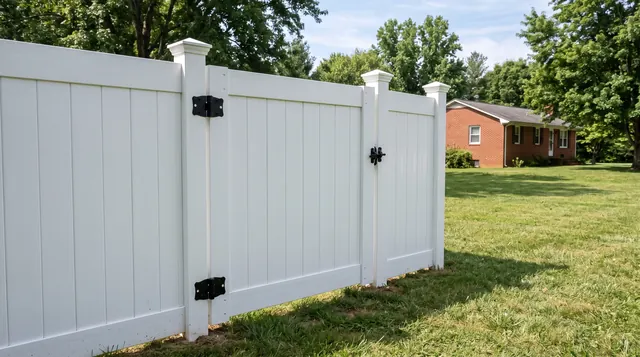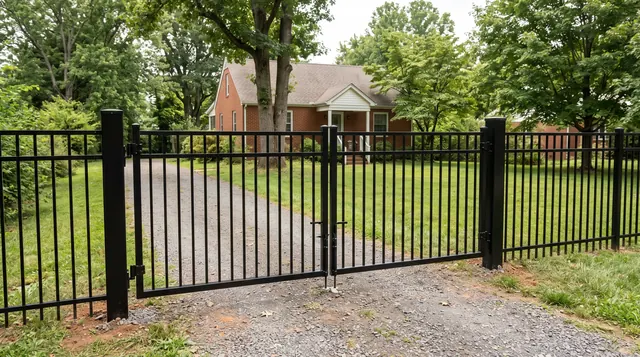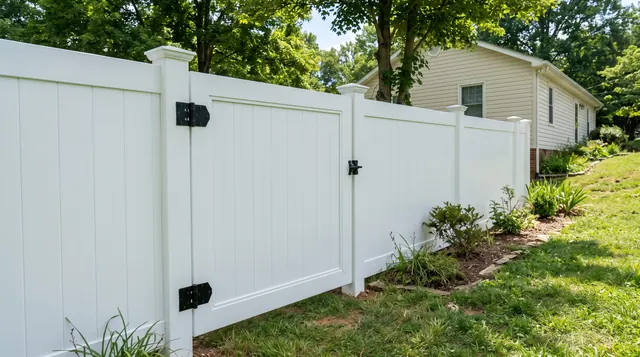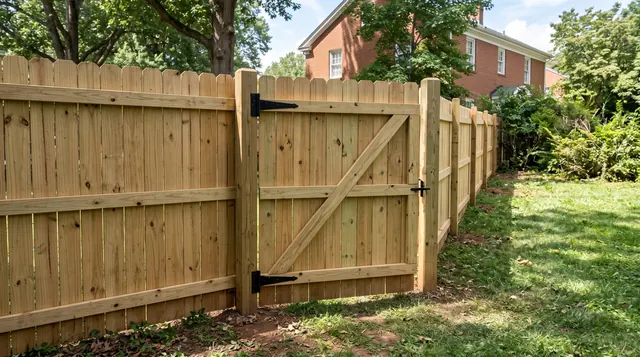
A gate that drags, opens into a parked car or barely admits the mower can make a good fence frustrating to use. Start with the opening and the route on either side. We plan walk gates and manual driveway access as moving parts of the complete enclosure.
Charlottesville Fence & Gate offers fence and gate installation across Charlottesville and the surrounding service area. We manage the work through fully licensed and insured contractors.
Start with the finished result
A frame carries the infill, hinges transfer the gate load to its support and a latch secures the closed leaf. Alignment depends on those parts and the ground beneath the travel path. A hardware change will not solve every moving-post or distorted-frame problem.
What happens at the project review
Send the project address, approximate footage and photos showing the line from both ends. Include the openings and the approach to the work area. We review the purpose, materials and retained components, then develop the installation scope. Any unresolved boundary, access or approval question stays visible before the layout is finalized.
Give the opening its own specification
A gate is a moving assembly within a mostly stationary fence. Its frame, posts, hinges and latch need to work together at the chosen span. The usable opening is the clear space left for people or equipment after the supports and hardware are accounted for. It can differ from the nominal size used to describe the gate.
Show what must pass through: a mower, wheelbarrow, trailer or everyday pedestrian route. Also show where the leaf can move and where it will rest when open. Slope, planting and parked vehicles can interfere even when the closed gate looks well positioned. A latch should be reachable by the intended user without making the enclosure awkward to secure. Plan these details with the fence so that a convenient opening is not squeezed into the only remaining space.
Put the walk gate on the route people use
An everyday gate should connect useful places: the back door and path, the driveway and yard, or the garden and tool storage. A convenient position reduces the temptation to leave the opening unsecured. Check the space with the leaf open as well as closed so it does not occupy the only standing room or catch on planting.
Plan for the things people carry or push through. A clear opening that works for walking may not accommodate a wheelbarrow or mower. Hinges, stops and the latch need to suit the frame and the intended use. Do not rely on a residential yard-gate detail for a swimming-pool barrier; that use has separate requirements for the complete barrier and gate arrangement. Explain the purpose at the start so the chosen opening is appropriate before the fence line is fixed.
Check the vehicle approach before choosing the gate
The width of a vehicle is only one part of a driveway-gate plan. A trailer may need to turn before reaching the opening, and the driver needs space to wait while the gate is opened. Show the approach, public-road connection and any place vehicles regularly park. Do not assume the road shoulder can serve as a waiting area.
A swing gate needs a clear arc on the property and suitable ground beneath it. A sliding system needs room for the leaf to travel beside the opening and supports appropriate to that system. A double swing can divide the span between leaves, but it still needs a closing arrangement and suitable posts. Manual access is the scope discussed here. Powered operation introduces a separate safety, equipment and electrical design; it is not included by choosing a gate that might later accept an operator.
Posts and footings carry the work
Posts support the fence, but they do not all carry the same load. A line post supports the intervening run. A corner, end or gate post may also resist tension, a change of direction or the weight of a moving gate. Simply matching the appearance of the existing posts does not establish that they are suitable for the new system.
Embedment and footing dimensions depend on the selected fence, soil, exposure and loads. A taller solid screen has different demands from an open rail boundary. Ground that looks firm at the surface can behave differently at the proposed footing. The specification should identify the installation method and the relevant product requirements. We work through those decisions with the installation contractor; a single universal hole depth is not an adequate plan for every property or gate.
Plan this project with us
Get an Estimate. Tell us what needs to change and send photos of the route and openings.
Corners and transitions deserve a close look
A corner changes the direction of the fence and may also change the loads carried by its supports. A junction between materials can create a different spacing or attachment problem from a straight run. Those points deserve attention on the plan because they are where a simple per-foot description often leaves important work undefined.
Show connections to existing fencing, walls and buildings. Do not assume the new fence can be fixed to another structure without reviewing the attachment and ownership. Where a gap matters for containment, explain how the transition will close without blocking a drain or interfering with a moving gate. Where appearance matters most, compare the view of the corner from both sides. A consistent top line is useful, but it should not conceal an unsuitable support or an unworkable opening.
Follow the grade without losing the purpose
Ground level can change significantly between the ends of a fence run. A rackable system follows a slope within the limits of its particular panels. A stepped layout keeps sections level and changes elevation between them. Neither approach automatically solves every problem: stepping can leave a larger space under a panel, while racking changes the relationship between the infill and the ground.
The right choice depends on what the enclosure must do. A decorative boundary may tolerate a gap that would defeat a small-dog enclosure. A privacy screen can lose coverage when the viewer stands uphill. Review the route from both sides and include the gate area, where a moving leaf needs clearance through its entire travel. The final layout should describe these transitions rather than leave them to be improvised after the posts are installed.
Establish the route before placing the posts
A fence marks the line where it is built; it does not establish the legal property boundary. Start with the survey or plat and any recorded documents affecting the route. An old fence may have been placed inside the property, moved around a tree or built with a neighbor's informal agreement. A line on a public mapping website is useful for orientation, but it is not a substitute for resolving an uncertain boundary.
Identify the corners before ordering sections. If the route changes after the posts are set, the correction can involve more than moving a few boards. Gates, panel lengths and the appearance of the return all depend on those positions. Tell us about disputed or missing markers early so that the installation layout can wait for the right boundary evidence.
Make the estimate describe the same finished fence
A useful estimate identifies the route, footage, material, height, board or panel arrangement and gate openings. It should say what removal is included and what happens to old concrete. Finish work, survey services and approval fees should be visible rather than hidden in a vague expectation that everything is covered.
Compare proposals against that description. A lower total may reflect a different product, fewer gates or less removal. Ask about the difference before deciding that two prices cover the same work. For standard residential installation, the Charlottesville-area starting range is about $20 to $45 per linear foot. Gates and unusual site work add to that fence-run budget. Horse facilities, commercial security systems and temporary construction enclosures need their own project scope rather than a residential price applied to a different job.
Review the installed route and the moving parts
At completion, compare the installed work with the accepted layout and material description. Review the transitions, any retained components and the gate operation. A gate should be assessed through its travel, not only photographed in the closed position. Ask how the latch and any drop rods are intended to be used.
Keep the product information and agreed scope for future maintenance or a damaged-section inquiry. Report changes such as a dragging gate, loose attachment or moving post rather than forcing the opening or adding improvised hardware. The cause may be in the support, frame, ground or connection, and those require different responses. A completion review is also the time to settle the removal and cleanup items listed in the scope, including what has deliberately remained below ground.
Compare the actual choices
| Choice | Useful when | Check before deciding |
|---|---|---|
| Walk gate | Everyday pedestrian route | Usable clearance and latch reach |
| Manual driveway gate | Vehicle access | Approach and leaf travel |
| Powered system planning | Automation is being considered | Separate qualified safety and electrical scope |
Frames, hinges and latches work together
Gate frames hold the infill and help preserve the leaf geometry. Gate hinges transfer the load to the supports, while gate latches secure the closed position. A latch that no longer meets may be showing a problem elsewhere in the system. Review frame condition, hinge connections, post alignment and ground clearance before treating a new latch as the whole remedy. The installation scope should identify those components and the intended gate alignment.
Questions about fence and gate installation
Can I choose a gate before the fence?
Yes, useful access dimensions can guide the fence layout. Confirm the usable opening and supports before fixing adjoining sections.
Does gate installation include automation?
Powered operation needs a separate equipment, electrical and safety scope. The manual gate offer does not include an unconfirmed automation service.
What should I send for an estimate?
Send the address, a sketch or approximate length, photos and the purpose of the fence. Mark each gate and any old fencing to remove.
What can change the installation method?
The chosen system, ground conditions, slope and access can change how the work is carried out. Those items belong in the scope before installation.
Can the new work connect to another fence?
Show the junction and identify who owns the retained section. Its condition and attachment details need review before a connection is accepted.
Related services and planning
- Gate Installation in Charlottesville, VA
- Fence Replacement in Charlottesville, VA
- Wood Fence Installation in Charlottesville, VA
- Fence planning guide for the Charlottesville area
- Fence installation cost in the Charlottesville area
Get an Estimate for Fence and Gate Installation. Send the location and the result you want from the finished work.