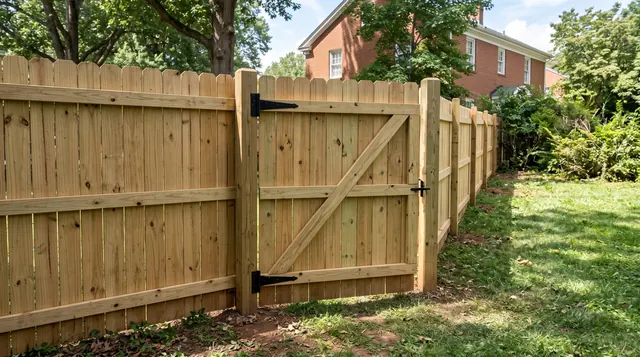
Choose the material with the span, frame and supports, not just the fence face. Weight and stiffness affect hinges and alignment. Wood infill can coordinate with a board fence, while metal systems have their own connection and finish requirements.
Charlottesville Fence & Gate helps property owners plan fence and gate work across the Charlottesville area, with installation managed through fully licensed and insured contractors.
The decision to work through
A wide wood-clad gate and a lightweight open metal leaf can load their posts differently. A matching face may conceal a separate supporting frame, and that frame needs to be part of the specification. Compare maintenance access, coating or finish care and how a damaged component would be replaced.
Give the opening its own specification
A gate is a moving assembly within a mostly stationary fence. Its frame, posts, hinges and latch need to work together at the chosen span. The usable opening is the clear space left for people or equipment after the supports and hardware are accounted for. It can differ from the nominal size used to describe the gate.
Show what must pass through: a mower, wheelbarrow, trailer or everyday pedestrian route. Also show where the leaf can move and where it will rest when open. Slope, planting and parked vehicles can interfere even when the closed gate looks well positioned. A latch should be reachable by the intended user without making the enclosure awkward to secure. Plan these details with the fence so that a convenient opening is not squeezed into the only remaining space.
Choose the wood and the board arrangement together
Pressure-treated pine and cedar are different material choices, not interchangeable labels for the same board. Treatment, grade, moisture condition and the intended use matter. Wood in contact with the ground needs the appropriate specification, and exterior fasteners must be compatible with the wood and any treatment. Ask for those details instead of comparing a price that says only wood fence.
The board pattern changes the result too. Board-on-board overlaps pickets to reduce direct gaps. A shadowbox alternates boards across the rails and gives a different appearance from each viewing angle. Stockade describes a close-board arrangement; a lattice-top design adds an upper element that needs its own support and overall-height review. Cedar or redwood availability, grade and suitability should be checked before a particular species is put into the accepted scope.
Bring the plan into focus
Get an Estimate. Send the address, photos and the question you are trying to resolve.
An ornamental boundary is more than its finish
An open metal fence can define the yard without creating a solid screen. Aluminum panel systems and steel assemblies differ in weight, connection details and maintenance needs. A decorative finish does not identify the underlying metal, and a product described as ornamental should not be assumed to have a particular security rating.
Look at how the panels meet the posts and how the finish is treated at cut edges, drilled holes and hardware connections. Corrosion resistance depends on the complete material and coating arrangement. Follow the product's installation and care instructions rather than adding an incompatible touch-up product. Where the yard slopes, the panel's permitted adjustment matters as much as the picket appearance. A system selected for an open front boundary also needs separate review before it is used as a pool barrier.
Posts and footings carry the work
Posts support the fence, but they do not all carry the same load. A line post supports the intervening run. A corner, end or gate post may also resist tension, a change of direction or the weight of a moving gate. Simply matching the appearance of the existing posts does not establish that they are suitable for the new system.
Embedment and footing dimensions depend on the selected fence, soil, exposure and loads. A taller solid screen has different demands from an open rail boundary. Ground that looks firm at the surface can behave differently at the proposed footing. The specification should identify the installation method and the relevant product requirements. We work through those decisions with the installation contractor; a single universal hole depth is not an adequate plan for every property or gate.
Plan for wood movement and future maintenance
Wood responds to moisture and exposure. Boards can change shape or spacing as they dry, and a finish does not stop every dimensional change. The selected board pattern and fastening method need to accommodate the material rather than assume that each board will remain exactly as delivered.
Staining or sealing is a separate scope unless it is included explicitly. Product instructions govern surface preparation and the condition the wood needs to be in before application. Keep soil, piled leaves and persistent plant contact away from the fence where practical, and watch the areas around posts and lower rails. When comparing designs, consider how you will reach both faces for inspection and maintenance. A fence tucked tightly behind a hedge may be difficult to care for even if the first installation is straightforward.
Questions before you decide
What information is most useful at the start?
The address, proposed route, intended purpose and photos help define the question. Add the product information or existing-fence details when you have them.
Can a photograph settle the whole scope?
Photos help with the first discussion, but they do not establish hidden conditions, boundaries or approval. Keep those questions separate from the appearance of the fence.
What is the next step?
Choose the outcome you need, identify the unresolved decisions and request an estimate with that information. The written scope should describe the system and work before installation.
Related service and guides
- Gate Installation in Charlottesville, VA
- Fence planning guide for the Charlottesville area
- Fence installation cost in the Charlottesville area
- Survey before fence installation
- What happens during fence installation
Get an Estimate. Tell us where the property is and what needs to change.