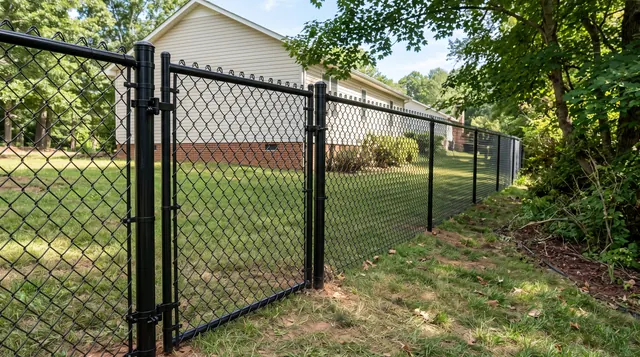
Charlottesville Fence & Gate offers fence and gate installation in Orange, VA, managing the work through fully licensed and insured contractors. Tell us what needs to change, then we can plan the route, material and openings around that purpose.
Start with the property, not just the panel
The Town of Orange has a Community Development department responsible for its zoning administration. An Orange postal address outside the town can involve a different review path. Resolve that distinction before treating a fence design as accepted.
For a town-frontage request, show the building, path and private boundary together. The line that looks most continuous from the street may not leave the useful gate position or the necessary room around a driveway entrance.
A rear enclosure may connect to several retained features: another fence, an outbuilding or a planting edge. Identify ownership and attachment questions at each transition. A material selection should follow that layout, with the product recorded for future maintenance.
A layout decision to compare
Consider a front boundary that turns into side-yard access. This is a planning example, not a claim about a completed customer job. The path reaches the fence close to a corner. Compare the hinge side and standing area so the open leaf does not obstruct the turn. Review the route under the authority for the parcel rather than assuming a county answer settles town zoning.
Discuss your Orange fence
Get an Estimate for Your Orange Property. Include the address, the purpose of the enclosure and the openings you need.
Separate public approval from private requirements
Begin with the jurisdiction for the actual address. A Charlottesville mailing address does not by itself tell you that the city administers the property. Building review, zoning restrictions, visibility near an entrance and any special property conditions are separate questions. An exemption from a building permit does not necessarily settle the others.
Association covenants and architectural review also operate separately from public approval. Obtain the requirements that apply to your property and submit the actual proposed design when a review is needed. Include the material, height, route and gate locations. Approval of a neighbor's fence, or a style visible elsewhere in the neighborhood, is not approval of yours. Keep the accepted drawing with the project information so the selected system and installed route can be checked against the same description.
Set the frontage and the everyday opening
A picket fence defines an edge through its posts, rails and individual upright members. Picket shape, spacing and top profile influence the appearance, but the location of the line often matters more to everyday use. Leave room for the path, planting and the gate swing you need rather than treating the property edge as an automatic installation route.
Street-facing work needs a review of visibility and the public right-of-way. A low decorative fence can still be poorly placed near a driveway or corner. An existing hedge, sidewalk edge or mowing line is not reliable proof of the legal boundary. If the picket fence is also expected to contain an animal, evaluate the openings and ground gaps separately. The attractive front elevation and the functional enclosure should be part of the same accepted plan.
Corners and transitions deserve a close look
A corner changes the direction of the fence and may also change the loads carried by its supports. A junction between materials can create a different spacing or attachment problem from a straight run. Those points deserve attention on the plan because they are where a simple per-foot description often leaves important work undefined.
Show connections to existing fencing, walls and buildings. Do not assume the new fence can be fixed to another structure without reviewing the attachment and ownership. Where a gap matters for containment, explain how the transition will close without blocking a drain or interfering with a moving gate. Where appearance matters most, compare the view of the corner from both sides. A consistent top line is useful, but it should not conceal an unsuitable support or an unworkable opening.
Plan the route for materials and equipment
The installation route is not always the same as the delivery route. A driveway may accommodate a vehicle while a narrow side passage limits what can reach the fence line. Steps, overhead branches, soft ground and an existing gate can change the handling or excavation method.
Send photos showing the approach from the street as well as the proposed fence. Tell us what must be protected, where materials can be staged and whether another owner controls any part of the access. Permission to enter a neighboring yard or shared drive should be settled before the work is scheduled. Do not assume a public path or open space is available for delivery. With access understood, the scope can describe the method and any necessary protection rather than build an estimate around equipment that cannot reach the work.
Follow the grade without losing the purpose
Ground level can change significantly between the ends of a fence run. A rackable system follows a slope within the limits of its particular panels. A stepped layout keeps sections level and changes elevation between them. Neither approach automatically solves every problem: stepping can leave a larger space under a panel, while racking changes the relationship between the infill and the ground.
The right choice depends on what the enclosure must do. A decorative boundary may tolerate a gap that would defeat a small-dog enclosure. A privacy screen can lose coverage when the viewer stands uphill. Review the route from both sides and include the gate area, where a moving leaf needs clearance through its entire travel. The final layout should describe these transitions rather than leave them to be improvised after the posts are installed.
Fence systems and access options
Compare wood, vinyl, aluminum and chain link for the yard. Gates belong in the initial layout. Horse fencing, commercial work and temporary construction enclosures have separate planning scopes.
How we handle a Orange project
Send the exact Orange address and photos from the entrance to the proposed line. We review the intended use, any retained fencing and the approach for installation. Identify the documents and review process for the Town of Orange and Orange County, along with any private requirements. The written scope brings those decisions together before the work is scheduled.
Questions about fencing in Orange
Where do I begin for a fence inside the Town of Orange?
The town’s Community Development process is a starting point for zoning questions. Confirm the parcel and ask what review applies to the proposed route and use.
What if the gate is close to a path corner?
Check the hinge side, standing space and leaf travel together. Keep the open gate from occupying the space needed to make the turn.
Which parts of the scope should I settle first?
For a front boundary that turns into side-yard access, begin with the purpose, proposed line and the access it needs. Compare the drawing with your boundary documents before choosing the final system.
What does residential fencing cost here?
Use a Charlottesville-area starting range of about $20 to $45 per linear foot for residential installation. Gates, removal and difficult site work add to the total. A commercial, equestrian or temporary-fencing project needs its own scope rather than the residential range.
Can I include a gate and existing-fence removal?
Yes. Mark the opening and the sections to remove on the Orange sketch. Specify what needs to pass through the gate, and ask for retained posts or concrete footings to be identified in the estimate.
Nearby service areas
- Fence Installation in Gordonsville, VA
- Fence Installation in Madison, VA
- Fence Installation in Louisa, VA
Plan the next step
- Fence planning guide for the Charlottesville area
- Fence installation cost in the Charlottesville area
- Fence utility locates and easements
Get an Estimate for Your Orange Fence. Send the location, approximate route and what you need the finished work to do.