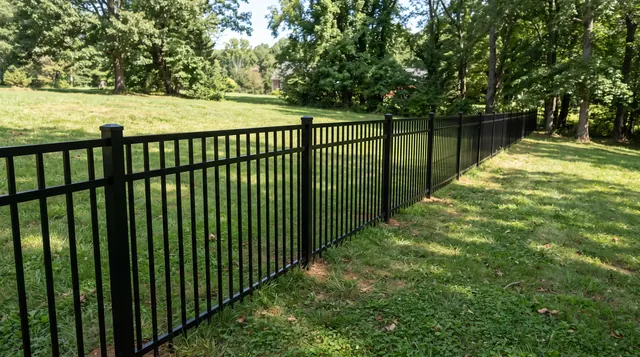
Charlottesville Fence & Gate offers fence and gate installation in Ivy, VA, managing the work through fully licensed and insured contractors. Tell us what needs to change, then we can plan the route, material and openings around that purpose.
Start with the property, not just the panel
Ivy Road and the Route 250 corridor connect the area west of Charlottesville. A fence request along that corridor needs the private entrance and work route identified, rather than assuming a delivery can stop beside the proposed frontage.
For an Ivy yard with established planting, mark what stays before the fence line is finalized. A hedge may screen the route but does not identify the legal boundary. Leave a practical way to inspect and maintain the new fence behind vegetation.
Where the proposed line crosses a wet area or changes level, show those conditions in the first photos. The solution may be a changed route or a separate drainage discussion. Ordinary fence panels should not be expected to retain soil or block flowing water.
A layout decision to compare
Consider a replacement behind mature garden planting. This is a planning example, not a claim about a completed customer job. The old wood run is partly hidden by shrubs. First identify the boundary and which plants remain, then compare the room needed for removal with the finished fence line. Include maintenance access to both faces so the new finish is not impossible to reach.
Discuss your Ivy fence
Get an Estimate for Your Ivy Property. Include the address, the purpose of the enclosure and the openings you need.
Choose the wood and the board arrangement together
Pressure-treated pine and cedar are different material choices, not interchangeable labels for the same board. Treatment, grade, moisture condition and the intended use matter. Wood in contact with the ground needs the appropriate specification, and exterior fasteners must be compatible with the wood and any treatment. Ask for those details instead of comparing a price that says only wood fence.
The board pattern changes the result too. Board-on-board overlaps pickets to reduce direct gaps. A shadowbox alternates boards across the rails and gives a different appearance from each viewing angle. Stockade describes a close-board arrangement; a lattice-top design adds an upper element that needs its own support and overall-height review. Cedar or redwood availability, grade and suitability should be checked before a particular species is put into the accepted scope.
Plan for wood movement and future maintenance
Wood responds to moisture and exposure. Boards can change shape or spacing as they dry, and a finish does not stop every dimensional change. The selected board pattern and fastening method need to accommodate the material rather than assume that each board will remain exactly as delivered.
Staining or sealing is a separate scope unless it is included explicitly. Product instructions govern surface preparation and the condition the wood needs to be in before application. Keep soil, piled leaves and persistent plant contact away from the fence where practical, and watch the areas around posts and lower rails. When comparing designs, consider how you will reach both faces for inspection and maintenance. A fence tucked tightly behind a hedge may be difficult to care for even if the first installation is straightforward.
Plan the route for materials and equipment
The installation route is not always the same as the delivery route. A driveway may accommodate a vehicle while a narrow side passage limits what can reach the fence line. Steps, overhead branches, soft ground and an existing gate can change the handling or excavation method.
Send photos showing the approach from the street as well as the proposed fence. Tell us what must be protected, where materials can be staged and whether another owner controls any part of the access. Permission to enter a neighboring yard or shared drive should be settled before the work is scheduled. Do not assume a public path or open space is available for delivery. With access understood, the scope can describe the method and any necessary protection rather than build an estimate around equipment that cannot reach the work.
Keep water and ground conditions in the plan
A fence is not a retaining wall or a drainage system. Soil should not be piled against ordinary panels to close a gap, and a solid lower edge should not be used to dam a flow path without appropriate design. Tell us where water crosses the proposed route and show the area after wet weather if you have useful photographs.
Persistent wetness can affect excavation, wood exposure and access for installation. A photograph of standing water does not establish the cause or specify a footing. The work may need a changed route, different materials or separate help with the drainage problem. Where a fence meets a retaining feature, the loads and attachment arrangement need their own review. Keep those responsibilities explicit so a fence estimate does not quietly become a promise to solve unrelated ground or wall movement.
Posts and footings carry the work
Posts support the fence, but they do not all carry the same load. A line post supports the intervening run. A corner, end or gate post may also resist tension, a change of direction or the weight of a moving gate. Simply matching the appearance of the existing posts does not establish that they are suitable for the new system.
Embedment and footing dimensions depend on the selected fence, soil, exposure and loads. A taller solid screen has different demands from an open rail boundary. Ground that looks firm at the surface can behave differently at the proposed footing. The specification should identify the installation method and the relevant product requirements. We work through those decisions with the installation contractor; a single universal hole depth is not an adequate plan for every property or gate.
Fence systems and access options
Compare wood, vinyl, aluminum and chain link for the yard. Gates belong in the initial layout. Horse fencing, commercial work and temporary construction enclosures have separate planning scopes.
How we handle a Ivy project
Send the exact Ivy address and photos from the entrance to the proposed line. We review the intended use, any retained fencing and the approach for installation. Identify the documents and review process for Albemarle County, along with any private requirements. The written scope brings those decisions together before the work is scheduled.
Questions about fencing in Ivy
Should the fence go behind the existing hedge?
Compare boundary evidence, room for removal and future maintenance access first. A hidden line is not necessarily a workable or correctly placed one.
Can delivery happen directly from Ivy Road?
Do not assume that. Show the private entrance and a suitable place to stage materials so access is planned without relying on a roadside stopping space.
Which parts of the scope should I settle first?
For a replacement behind mature garden planting, begin with the purpose, proposed line and the access it needs. Compare the drawing with your boundary documents before choosing the final system.
What does residential fencing cost here?
Use a Charlottesville-area starting range of about $20 to $45 per linear foot for residential installation. Gates, removal and difficult site work add to the total. A commercial, equestrian or temporary-fencing project needs its own scope rather than the residential range.
Can I include a gate and existing-fence removal?
Yes. Mark the opening and the sections to remove on the Ivy sketch. Specify what needs to pass through the gate, and ask for retained posts or concrete footings to be identified in the estimate.
Nearby service areas
- Fence Installation in Crozet, VA
- Fence Installation in Pantops, VA
- Fence Installation in Earlysville, VA
Plan the next step
- Fence planning guide for the Charlottesville area
- Fence installation cost in the Charlottesville area
- Fence utility locates and easements
Get an Estimate for Your Ivy Fence. Send the location, approximate route and what you need the finished work to do.