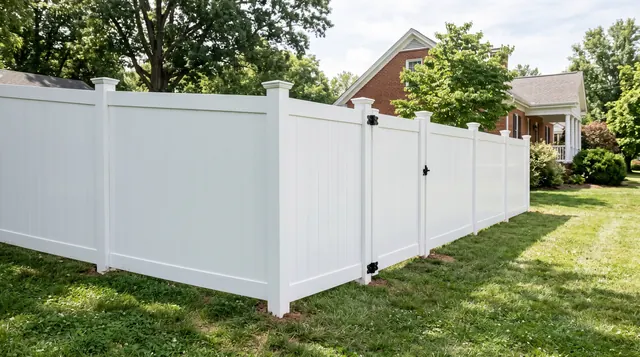
Choose by the appearance, screening and maintenance you want, then compare complete systems on the same route. Wood offers board-pattern flexibility and a finish decision; vinyl uses a coordinated panel and reinforcement system. Neither material removes the need for sound posts or a properly supported gate.
Charlottesville Fence & Gate helps property owners plan fence and gate work across the Charlottesville area, with installation managed through fully licensed and insured contractors.
The decision to work through
A useful comparison keeps the purpose fixed. Compare two privacy designs or two picket designs, rather than a solid wood screen against an open vinyl rail and attributing every difference to material. Include both faces, the gate arrangement and the grade treatment. Ask how a damaged section would be replaced and how the product can be identified later.
Choose the wood and the board arrangement together
Pressure-treated pine and cedar are different material choices, not interchangeable labels for the same board. Treatment, grade, moisture condition and the intended use matter. Wood in contact with the ground needs the appropriate specification, and exterior fasteners must be compatible with the wood and any treatment. Ask for those details instead of comparing a price that says only wood fence.
The board pattern changes the result too. Board-on-board overlaps pickets to reduce direct gaps. A shadowbox alternates boards across the rails and gives a different appearance from each viewing angle. Stockade describes a close-board arrangement; a lattice-top design adds an upper element that needs its own support and overall-height review. Cedar or redwood availability, grade and suitability should be checked before a particular species is put into the accepted scope.
Treat vinyl as a complete panel system
Vinyl fencing is assembled from components designed to work together: posts, rails, infill and any specified reinforcement. A vinyl sleeve does not tell you what support is inside it. Gate posts in particular may need a different arrangement from the posts along a straight run. The accepted product specification should make that distinction clear.
Thermal movement, rail engagement and fastening details follow the manufacturer's system. Mixing parts because they look similar can leave an uncertain connection. On a slope, confirm whether the chosen product racks, steps or requires another treatment. Also ask what happens if a panel is damaged later: a matching replacement section may depend on the profile and product line. Keep the product identification with the project paperwork so a future repair conversation can begin with the actual system.
Bring the plan into focus
Get an Estimate. Send the address, photos and the question you are trying to resolve.
Plan for wood movement and future maintenance
Wood responds to moisture and exposure. Boards can change shape or spacing as they dry, and a finish does not stop every dimensional change. The selected board pattern and fastening method need to accommodate the material rather than assume that each board will remain exactly as delivered.
Staining or sealing is a separate scope unless it is included explicitly. Product instructions govern surface preparation and the condition the wood needs to be in before application. Keep soil, piled leaves and persistent plant contact away from the fence where practical, and watch the areas around posts and lower rails. When comparing designs, consider how you will reach both faces for inspection and maintenance. A fence tucked tightly behind a hedge may be difficult to care for even if the first installation is straightforward.
Follow the grade without losing the purpose
Ground level can change significantly between the ends of a fence run. A rackable system follows a slope within the limits of its particular panels. A stepped layout keeps sections level and changes elevation between them. Neither approach automatically solves every problem: stepping can leave a larger space under a panel, while racking changes the relationship between the infill and the ground.
The right choice depends on what the enclosure must do. A decorative boundary may tolerate a gap that would defeat a small-dog enclosure. A privacy screen can lose coverage when the viewer stands uphill. Review the route from both sides and include the gate area, where a moving leaf needs clearance through its entire travel. The final layout should describe these transitions rather than leave them to be improvised after the posts are installed.
Choose where the budget makes the biggest difference
Decide which outcome matters most before trimming the scope. Screening a patio, enclosing a dog area and defining a frontage are different priorities. Reducing the route can change the price while preserving the intended result; removing necessary supports or gate hardware changes the system itself.
Compare a basic finish and a more decorative arrangement on the same drawing. Ask what maintenance each will need and whether the product is readily identifiable for future replacement parts. Keep essential access in the plan. A fence that saves money by omitting the only useful equipment gate may create another expense later. The estimate conversation should make these tradeoffs visible so a lower total represents a deliberate choice about the finished work rather than an overlooked part of the project.
Questions before you decide
What information is most useful at the start?
The address, proposed route, intended purpose and photos help define the question. Add the product information or existing-fence details when you have them.
Can a photograph settle the whole scope?
Photos help with the first discussion, but they do not establish hidden conditions, boundaries or approval. Keep those questions separate from the appearance of the fence.
What is the next step?
Choose the outcome you need, identify the unresolved decisions and request an estimate with that information. The written scope should describe the system and work before installation.
Related service and guides
- Wood Fence Installation in Charlottesville, VA
- Fence planning guide for the Charlottesville area
- Fence installation cost in the Charlottesville area
- Survey before fence installation
- What happens during fence installation
Get an Estimate. Tell us where the property is and what needs to change.