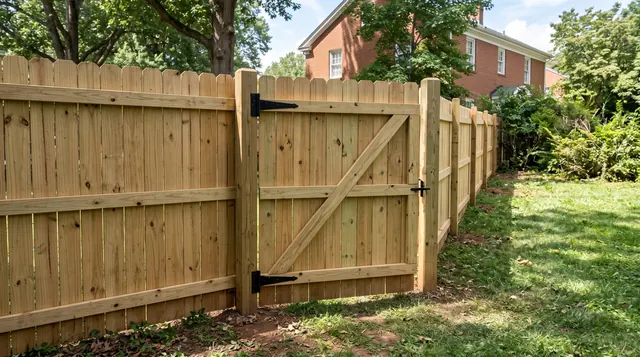
Measure the usable opening you need and show how the equipment approaches. Nominal gate size is only one part of the plan; posts, hardware, turning room and moving clearance all matter.
Charlottesville Fence & Gate helps Charlottesville-area property owners plan installation and replacement, with the work managed through fully licensed and insured contractors.
Start here
A mower that fits straight through may still be difficult when a path turns immediately inside the opening. A trailer needs an approach that allows its full movement. Draw the gate open and closed, mark nearby planting and parking, and show grade changes beneath the travel.
Give the opening its own specification
A gate is a moving assembly within a mostly stationary fence. Its frame, posts, hinges and latch need to work together at the chosen span. The usable opening is the clear space left for people or equipment after the supports and hardware are accounted for. It can differ from the nominal size used to describe the gate.
Show what must pass through: a mower, wheelbarrow, trailer or everyday pedestrian route. Also show where the leaf can move and where it will rest when open. Slope, planting and parked vehicles can interfere even when the closed gate looks well positioned. A latch should be reachable by the intended user without making the enclosure awkward to secure. Plan these details with the fence so that a convenient opening is not squeezed into the only remaining space.
Check the vehicle approach before choosing the gate
The width of a vehicle is only one part of a driveway-gate plan. A trailer may need to turn before reaching the opening, and the driver needs space to wait while the gate is opened. Show the approach, public-road connection and any place vehicles regularly park. Do not assume the road shoulder can serve as a waiting area.
A swing gate needs a clear arc on the property and suitable ground beneath it. A sliding system needs room for the leaf to travel beside the opening and supports appropriate to that system. A double swing can divide the span between leaves, but it still needs a closing arrangement and suitable posts. Manual access is the scope discussed here. Powered operation introduces a separate safety, equipment and electrical design; it is not included by choosing a gate that might later accept an operator.
Put the walk gate on the route people use
An everyday gate should connect useful places: the back door and path, the driveway and yard, or the garden and tool storage. A convenient position reduces the temptation to leave the opening unsecured. Check the space with the leaf open as well as closed so it does not occupy the only standing room or catch on planting.
Plan for the things people carry or push through. A clear opening that works for walking may not accommodate a wheelbarrow or mower. Hinges, stops and the latch need to suit the frame and the intended use. Do not rely on a residential yard-gate detail for a swimming-pool barrier; that use has separate requirements for the complete barrier and gate arrangement. Explain the purpose at the start so the chosen opening is appropriate before the fence line is fixed.
Put the details in one place
Keep your sketch, photos and accepted scope together. That gives the estimate or follow-up conversation a clear starting point without asking a single photograph to establish everything about the property.
Get an Estimate. Send the location and what you want to change.